Good day all!
I realise that I started talking about the foundation of folklore but kind of got off course. This post is my course correction to get us back on track (good thing I’m the only one grading me right now). So to recap: we have talked about the origins of folklore and what it is not, so you can imagine what’s next. That’s right, this time we’re talking about what folklore actually is.
I have to admit, when I realised that I’d skipped this (I have been working on a material culture focussed post) my therapist training kicked in. One of my core areas of practice, supervision, and research is around critical self-reflection which is really handy when I notice I’m evading or avoiding something. Part of critical self-reflection is noticing those patterns and (as Fook says) uncovering the story underneath so we understand our behaviour. In this case, my behaviour was really easy to understand. The reality is that I was avoiding a really tough post. More on critical self-reflection in future.
Now if you’re new to folklore, that might seem daft. How hard can folklore be? Well, I’m here to tell you that (it seems to me) that there are almost as many definitions as there are folklorists. I might have said that already, now that I think of it but it’s worth leaving in because it’s just that true. At the end of the post I’ll link to a bunch of folklore orgs and my alma mater to illustrate.
They’re not all dramatically different, not at all. And there are common, core themes but there are also very visible differences. The most important two things to remember about what folklore is is that it is usually (but not always) informal and often traditional. It becomes tricky because are East Coast fiddle songs folklore when they’re being taught formally? Sure because they’re traditional. Is a meme that makes the rounds for a week also folklore. Sure because it’s informal but it’s not traditional. I made something to demonstrate:
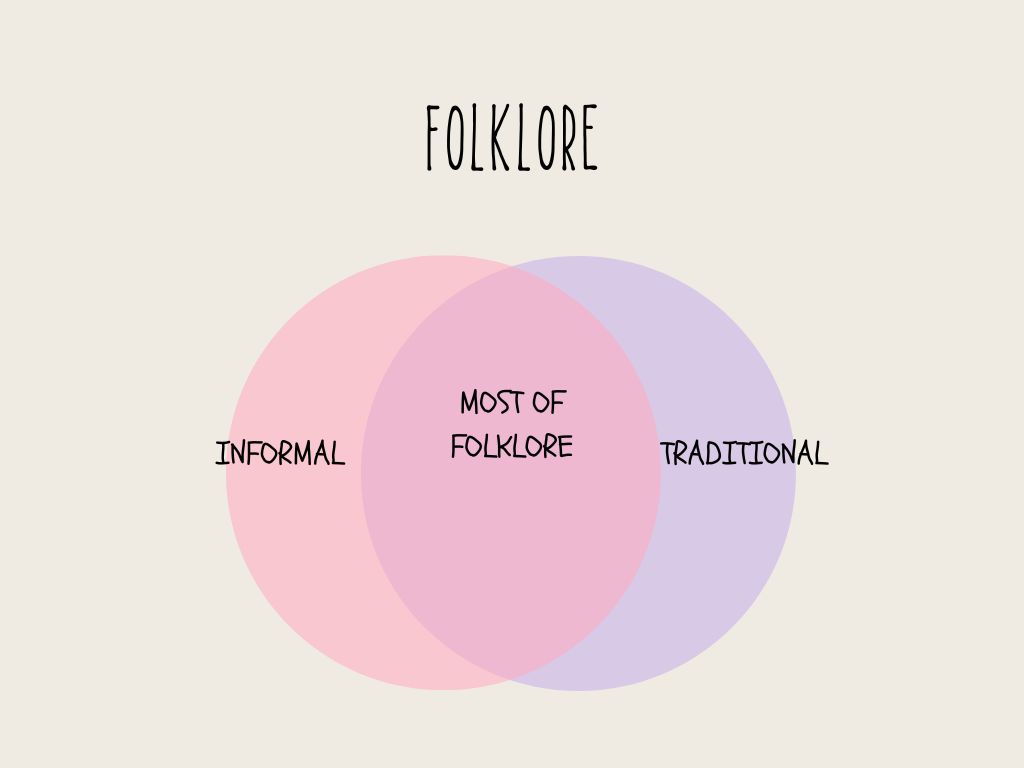
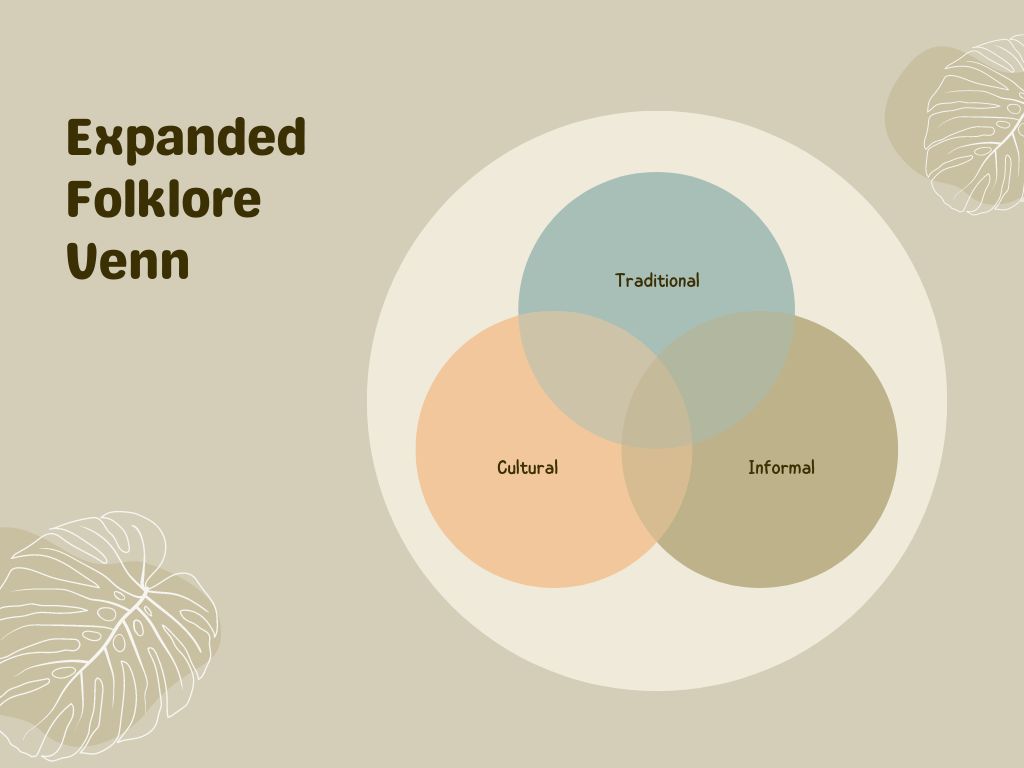
See, pretty clear. Sort of. Right? Honestly, if you remember it’s mostly informal and often traditional, you’re in good shape. The other thing about folklore, in my opinion, is that it’s often cultural too. Now there are those who try to argue that is the same as traditional but I don’t buy it and memes are a great example. They can last a very short time (so I don’t think you can argue that they’re traditional) and definitely reflect cultural elements. In fact, much as those like Dundes who studied jokes back in the day, if you show a folklorist who studies memes a meme, they can link it back to a cultural phenomenon. Lynne McNeil has a great TED Talk about this. This is what my Venn diagram looks like.
One of the tricks in folklore is, I think, that there are some folx who were trained at a different time and in a different way. That means those of us who study in a more modern paradigm are sometimes a little outside the core. I mean, there can be a strong traditionalist kind of vibe in folklore and it makes sense, especially given our origins but we have also evolved beyond that. This can mean that some don’t understand the work those of us in digital ethnography are doing, for example. My work is largely digital and textual ethnography, though I definitely interview and observe as well. Some have argued that the digital world is not a “field” in which to study. I argue that is not only misguided but it means that one misses so much engagement that happens. I mean, so many people are engaged in some form of social media or another that if you aren’t at least including social media and digital worlds, I suspect you may have missed important data.
I know there are those who disagree and that’s fine. I mean, they would have been the type of people who wanted to study the traditional dance of culture X and who pushed back against studying jokes. Now, people of that orientation can sort of see the study of memes as kind of an analogue of jokes but even back in the day, not everyone thought that what Dundes was doing made sense either. Jokes aren’t my thing but his work is fascinating, and no one can deny that he was able to articulate the relationship between jokes and culture. I should add Oring was also a great studier of jokes, different in tone but interesting too.
I would be remiss if I didn’t also point out that folklore is what we study, but it’s also the products that we study, the products of what we study, etc. Yeah, it gets confusing but there’s no better word for it.
To help it all make more sense, I will sign off here and close off with the range of definitions from a pretty narrow selection of orgs.
Does that all make sense? Ish? Feel free to send me a note to ask for clarification or more resources or… something about folklore.
Colleen
The excellent summary by noted folklorists compiled by the AFS
The AFS’s “What is Folklore” project. Highly recommended.
Memorial University’s Folklore Page
The Kule Centre at the U of Alberta wades in
and finally, the British Folklore Society

